Visiting Doha? Here's why you should pause while travelling through the airport

- July 30, 2026
- 25
- Travel
At Hamad International Airport in Doha, art is not set aside in a gallery wing. It appears beside arrival halls, above duty-free corridors, near boarding gates and inside an indoor garden, turning a layover into a quiet walk through some of Qatar’s most visible public art.
Most airports are designed to keep people moving. Hamad International Airport (HIA) does that too, but it also asks travellers to look up, slow down and notice what is around them. Between flight connections and boarding calls, passengers pass more than 40 permanent art installations, curated in collaboration with Qatar Museums. Some are playful, some are monumental, and some carry stories that are easy to miss when you are only looking for a gate number.
A wall left to the people who built the airport
In the Arrivals Meet and Greet Hall, Italian artist Rudolf Stingel’s work begins with a deceptively simple idea. During HIA’s construction, Stingel covered three surfaces with reflective, aluminium-faced insulation panels and invited members of the construction team to draw on them. The soft walls were later cast in copper and electroplated with gold, before selected panels were placed on permanent display.
What remains is not conventional airport art. It is a record of the hands that helped build the space: anonymous marks, names, drawings and gestures preserved in gold. The work gives the airport a rare human trace, especially in a place usually defined by polish, scale and speed.
The first greeting
The sense of place begins even before travellers reach the city. In the arrivals hall, Dutch artist Tom Claassen’s herd of eight bronze oryx sculptures appears to move together across the terminal. The oryx is Qatar’s national animal, and its presence here is both familiar and symbolic: a reminder of the desert landscape outside Doha and of an animal that was once brought back from near-extinction through conservation efforts.
Outside the departures entrance, Claassen’s monumental falcon continues the same conversation between local identity and movement. Its sweeping form draws from Arabic calligraphy and the folds of traditional Qatari attire, while also suggesting the flight paths that connect Doha to the wider world.
The yellow bear that became a landmark
Not every work at HIA needs explaining to be recognised. Lamp Bear by Swiss artist Urs Fischer has become one of the airport’s most photographed landmarks: a 23-foot canary-yellow teddy bear, cast in bronze, seated beneath a lamp in the main duty-free area.
It is easy to read the piece as cheerful spectacle, but Fischer’s idea is more layered than that. Lamp Bear plays with scale, memory and childhood familiarity. The object is domestic, almost ordinary, yet it becomes monumental inside the terminal. For passengers in transit, it offers a moment of softness in a highly controlled space. It is also useful in the way airport landmarks often become useful: people meet under it, photograph it, remember it and use it to navigate.
A star map in motion
Near Concourses D and E, Cosmos by French artist Jean-Michel Othoniel hangs like a suspended map of movement. The work takes inspiration from an astrolabe in the collection of the Museum of Islamic Art in Doha. Othoniel transforms that reference into a gilded steel globe that suggests paths, routes and changing points of view.
Viewed from different angles, Cosmos appears to shift. From the side or below, it can resemble calligraphy drawn in space. From the front, it opens into a rose-like form. That changing perspective feels suited to an airport, where almost everyone is passing through, arriving from one context and moving towards another.
The figure that changed the building around it
Near Concourse E stands Small Lie by KAWS, the artist Brian Donnelly. The 32-foot figure, made from Afrormosia wood, weighs 15 tonnes and resembles a wooden marionette, with its head bowed and hands crossed. It is large enough to dominate the space, yet its posture gives it an unexpected vulnerability.
Its installation also says something about the scale of HIA’s art programme. The airport operations team had to dismantle part of the facade at Concourse D to receive the crates, with technical installation work continuing for several weeks. KAWS has noted that this was the first time one of his works had been exhibited in an airport. In a terminal built for efficiency, Small Lie introduces pause, weight and a little uncertainty.
New residents in the orchard
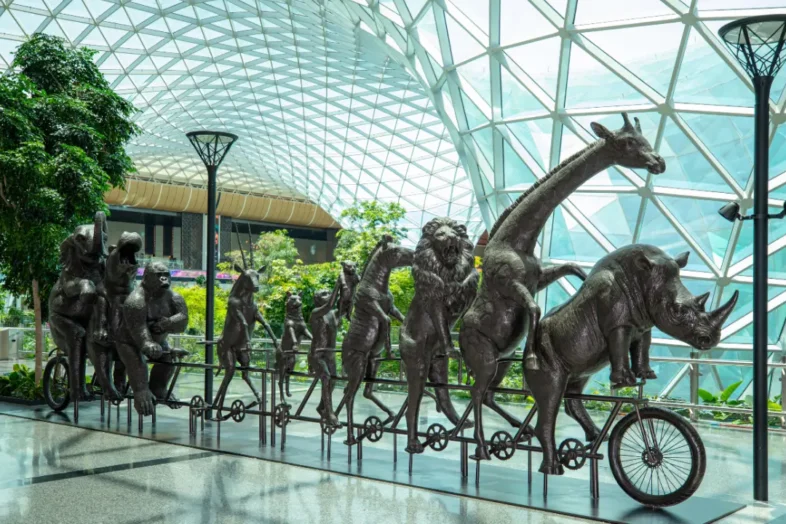
The most recent addition, Wildlife Wonderscapes by Australian artist duo Gillie and Marc, was unveiled in June 2025 at The Orchard, HIA’s indoor tropical garden. Among its highlights is Wild Table of Love in Doha, a 3.5 m x 10.5 m bronze dining table featuring native and endangered animals gathered together. The work weighs six tonnes and uses the idea of a shared table to speak about coexistence.
The wider collection includes a 10-metre sculpture and three versions of Falcon with Glove, connecting the artists’ global conservation language with Qatar’s falconry heritage. Installed among trees, light and water features, the works feel less like terminal decoration and more like an extension of the airport’s larger public-space ambitions.
The practical bit
For travellers with time between flights, airport’s art collection is open around the clock and requires no separate ticket. Qatar Museums offers a guided walking tour, while HIA’s transit experiences through Discover Qatar also include the installations as part of the layover experience.
That is what makes the collection interesting beyond its scale. It does not ask passengers to leave the airport or set aside a full day. It simply changes the nature of waiting. At HIA, the space between one flight and the next can become a short encounter with memory, craft, conservation, humour and place. The boarding call still comes, of course. But by then, the airport has already done more than move you along.



Add Comment